cintoo-logo

Going From Point Cloud Presentation to Project-Wide Performance 

Reality capture has become a standard part of modern renovation and new‑build projects, with point clouds captured from a wide range of devices (LiDAR, photogrammetry, and more) used to document existing conditions, validate progress, and reduce uncertainty. Yet many teams struggle to realize the full value of this data after capture.

Going beyond point cloud presentation is a guide for teams that already use reality capture and want to elevate their results by making scan data browser‑based, easy to share, hardware‑ and vendor‑agnostic, and connected to BIM and CAD workflows.
 

Eliminating Shared Pain Points

Across AEC firms, EPCs, asset owners, reality capture specialists, construction managers, and BIM/CAD modelers, the pain points are remarkably consistent: 
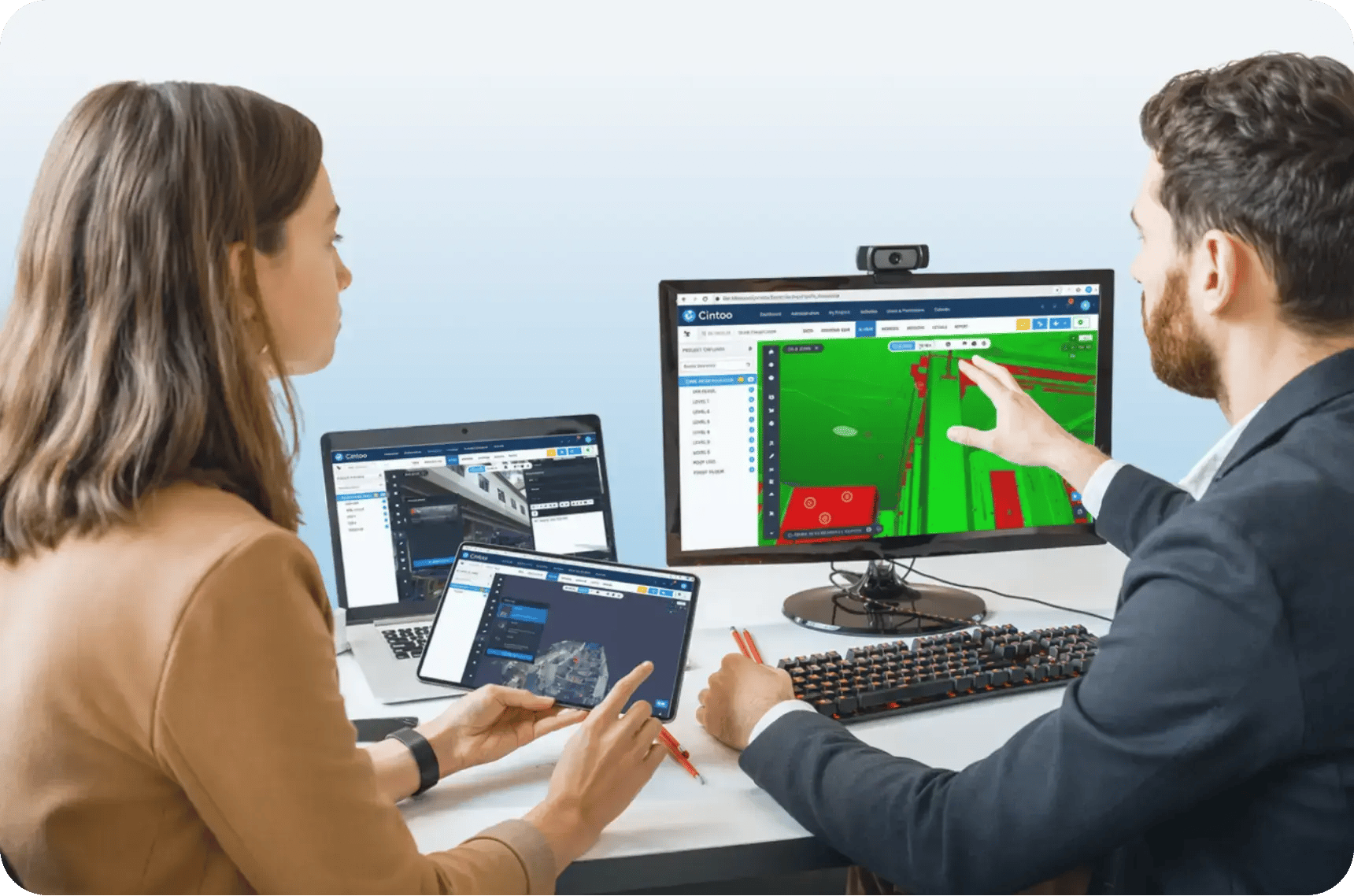
Massive point cloud files that are hard to render
Limited ability to share access with clients plus many stakeholders needing access
Too many file formats (E57, RCP, LAS, LAZ, RVT, NWD, IFC, DWG…)
Reporting progress without clear visual proof
Switching constantly between models and scan viewers
Fear of deviations turning into costly rework
Difficulty validating design intent against real conditions
Pressure to compete the work in time and differentiate from competition
Archival data that cannot be easily reused
eliminating-shared-pp

To sum it up, the question today is not: are you scanning? (answer – everyone is or should). Instead, the question is: how effectively are you using what you capture?

From Siloed Point Clouds to Shared Reality

To level up reality capture results, teams must shift their focus from data creation to data democratization. Democratization, however, does not mean “simplifying” the data. It means: 

Making high-fidelity scan data accessible in a browser
Box Image 2
Removing specialized hardware barriers 
Group 15799 (1)
Allowing non-technical stakeholders to engage directly 
Group 15799 (2)
Connecting scan data to BIM, CAD, and project workflows 
Box Image 3
Standardizing collaboration across teams 
Box Image 4
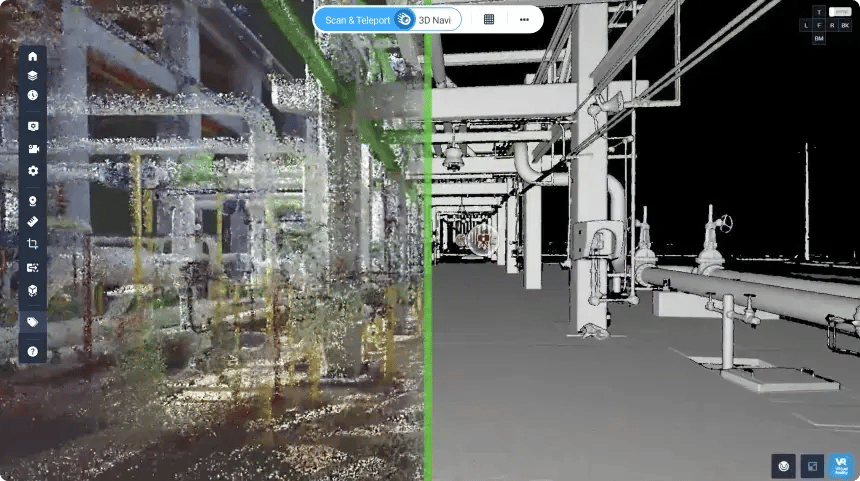
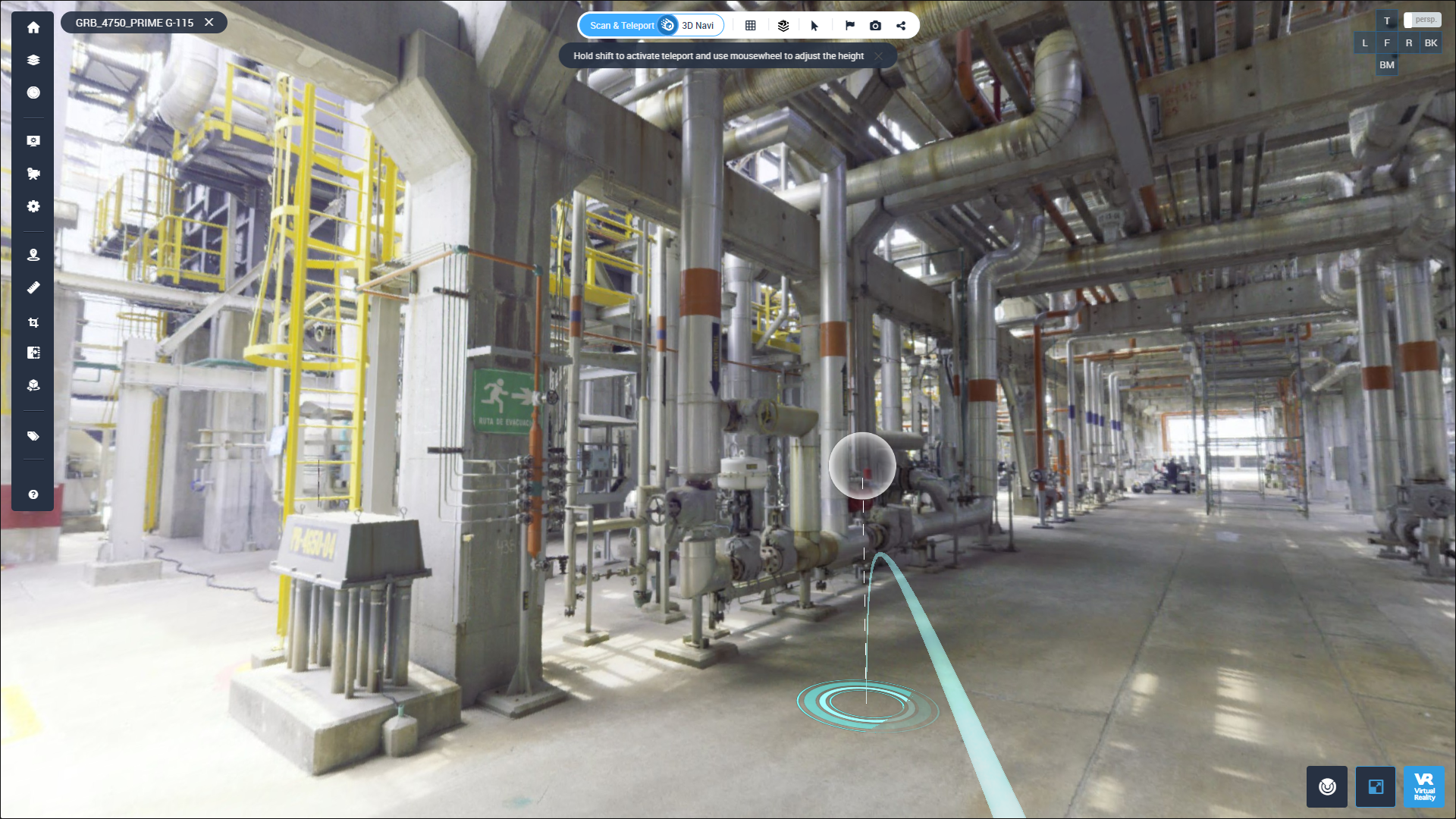
When reality data becomes accessible, it becomes usable enough to drive measurable outcomes. Cintoo removes these barriers to access by transforming raw scan data into high-fidelity 3D meshes streamed through a standard web browser. It means no specialized hardware, software, file transfers or expertise is required.

Using its proprietary TurboMesh technology, scan data is transformed into 3D meshes and streamed directly in the cloud. As a result, project stakeholders can access full‑resolution scans from anywhere, without installing software or investing in expensive hardware.
comparison

Because Cintoo preserves the accuracy and visual richness of the original scan data with no decimation, users do not have to trade performance for accessibility. The result is a platform that supports both technical analysis and non‑technical engagement, ensuring everyone works from the same mesh-based reality. 

Hardware and Vendor-Agnostic by Design

Projects rarely rely on a single scanner, vendor, or data source. Over time, organizations accumulate scan data from different technologies, service providers, and scan formats. Without an agnostic platform, this diversity can become challenging to handle or, even worse, discouraged entirely.

Cintoo is designed to be hardware‑ and vendor‑agnostic, allowing teams to bring together scan data from multiple sources into a single, cohesive environment. This ensures that reality capture investments remain future‑proof and flexible as technologies evolve. For instance, Cintoo supports E57, RCP, and PLY, along with other file format options for drone and mobile scanners (E57, LAS or LAZ).
Exporting point clouds in Cintoo is also a robust process, providing options for exporting reality data in structured or unstructured file formats: Scan data can be exported as a structured E57 or structured RCP file. Scan data can also be exported as a unified E57, RCP, RCS (Autodesk ReCap format), or POD (Bentley Point Tools) file, resulting in one globally unified point cloud with options to adjust decimation. 

hardware
Data integration is also a first and foremost capability of the platform. Leading industry integrations allow possible bidirectional workflows to operate easily. By supporting native connections between Autodesk Construction Cloud, NewForma Konekt & Procore, and also Revit (Plugin) and ArcGIS (widget), users can move beyond simple viewing processes to draw more tangible insight. 
ebook 2 img 3

When Reality Meets Design

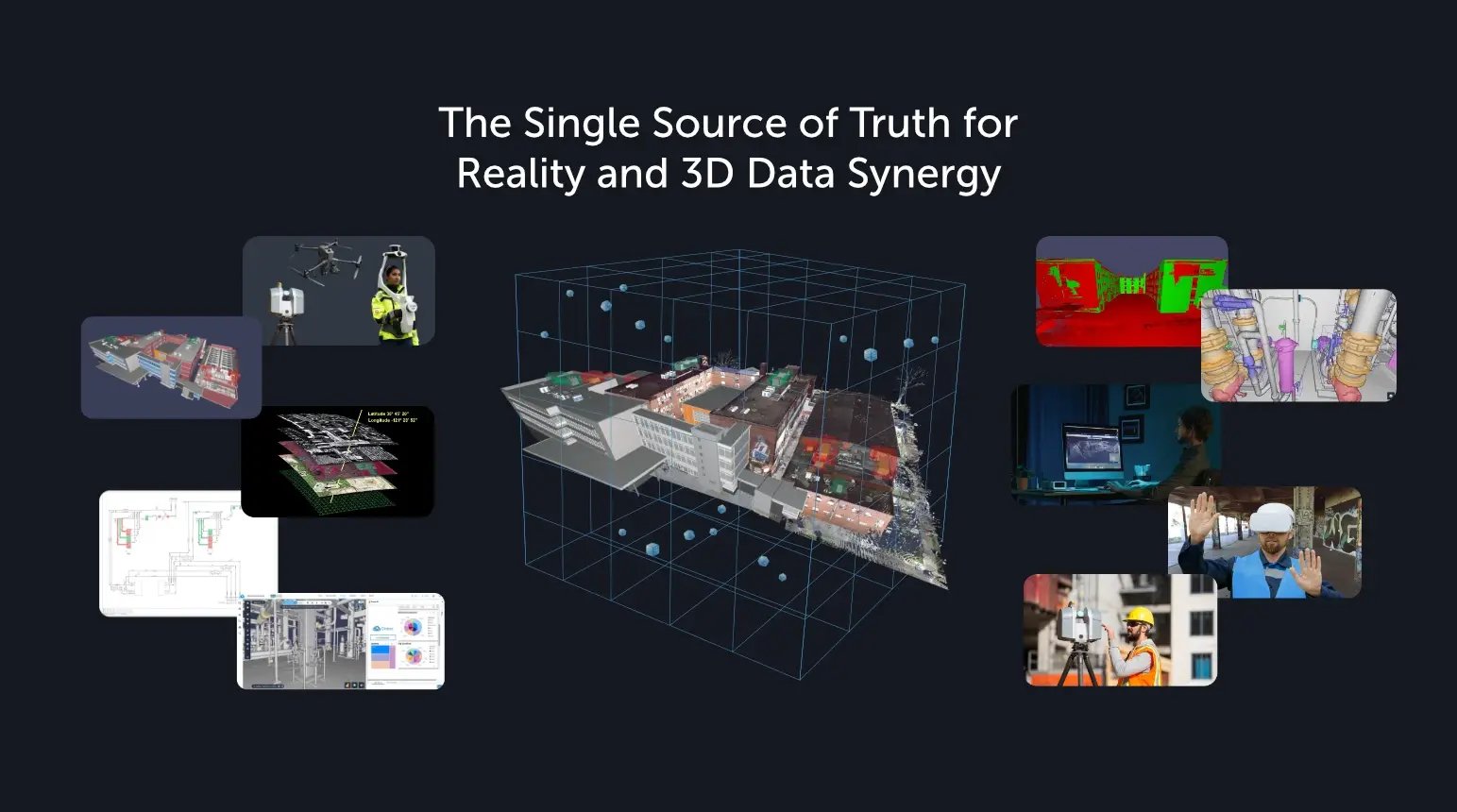
Reality capture becomes exponentially more valuable when it is connected to design intent. Comparing scan data to BIM and CAD models allows teams to validate designs, detect deviations, and resolve issues early.

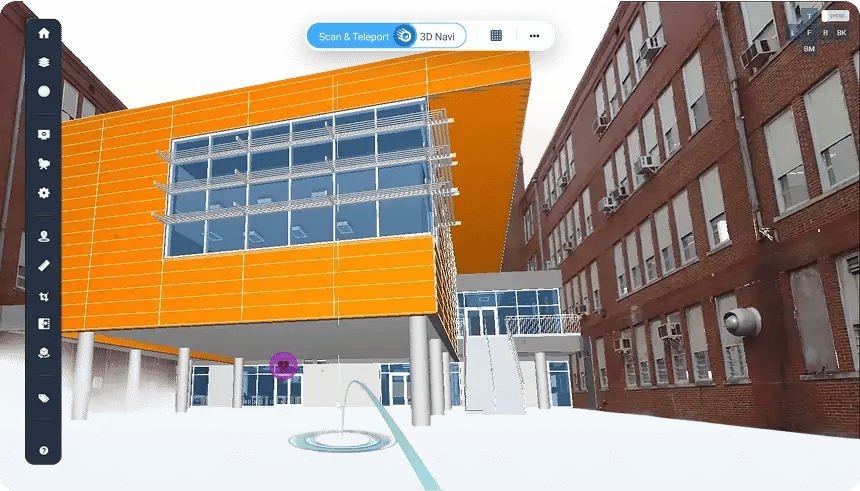
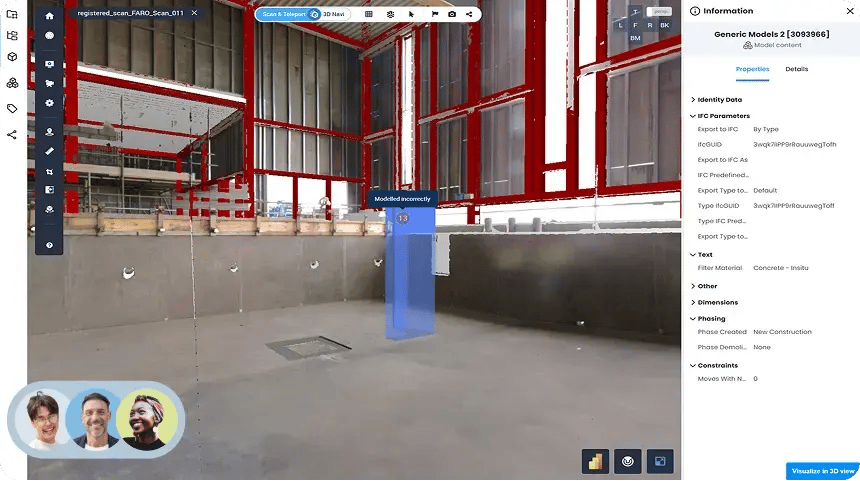
Cintoo enables scan data and BIM/CAD models to coexist in a single interface, eliminating the need to jump between tools or manually align datasets.

This capability supports a wide range of workflows: 
Verifying that construction matches design intent
Identifying clashes, misalignments, or installation errors
Supporting quality control and progress verification
Validating retrofits, renovations, or upgrades
when reality meets design


Because this comparison happens directly in 3D context, issues are easier to understand and communicate. Instead of abstract reports, teams can point to the exact location where reality and design diverge, use Cintoo’s comparison tool to detect deviations, and send secure access links or create annotations for their team members to see.
When reality meets design 2

This reduces misunderstandings, accelerates issue resolution, and significantly lowers the risk of costly rework.

Tracking Issues and Progress in Context

Traditional issue tracking systems describe problems only on 3D design models and/or 2D drawings.
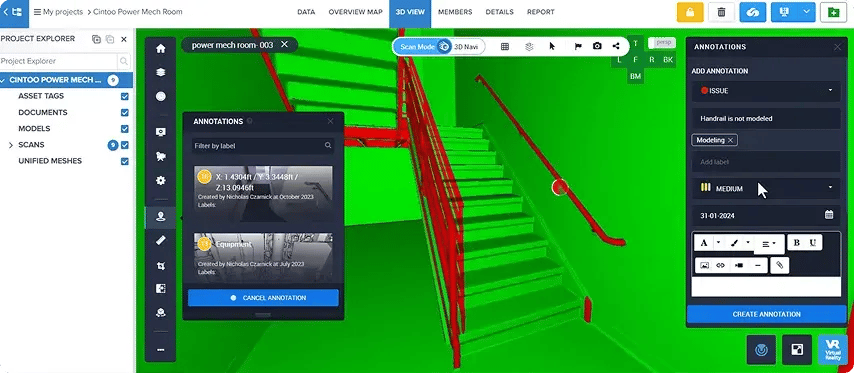
Cintoo anchors issue tracking directly inside the 3D environment.

This allows teams to:

 

qa-qc

See problems exactly where they occur with precision

3d-measure

Measure and Annotate directly in 3D 

Group 15683

Assign responsibility
 

image 91

Track resolution and confirm visually, using Cintoo’s Resolved parameters 

Reports don’t have to be abstract; instead, in Cintoo, they become reference sources of truth so that the project stays on track.

Simplifying Handoff and Expanding Shareability to Stakeholders

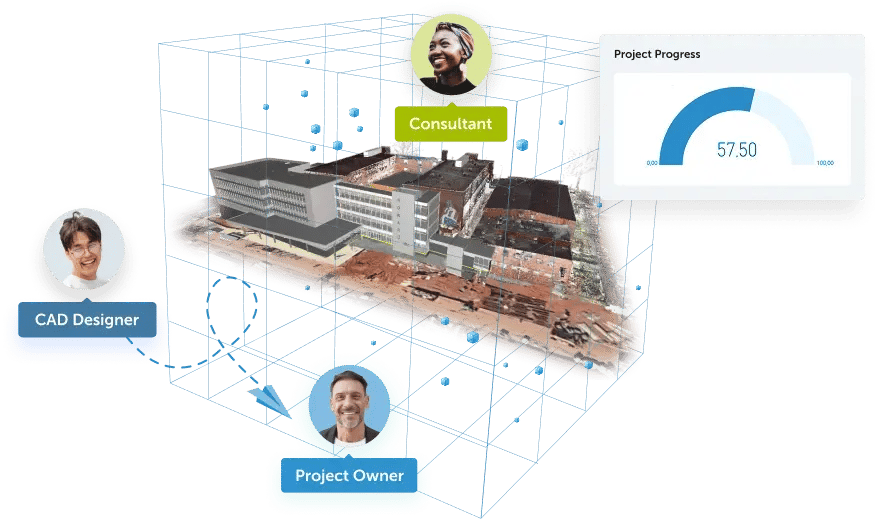
One of the most powerful benefits of web‑based reality capture is the ability to share projects widely and securely. Cintoo enables teams to invite users, assign permissions, and control access without duplicating data or compromising performance. This makes it easier to engage clients and owners, designers and consultants, contractors and subcontractors, and remote and global teams. 
Frame 15901

By giving stakeholders direct access to reality, conversations become more productive and proactive, rather than reactive. Questions are resolved faster, alignment improves, and fewer decisions are made based on assumptions. 

Collaboration at a Global Scale

Modern projects are increasingly distributed. Teams work across offices, regions, and time zones. Reality capture must support these processes in order to bring the most benefit and value, not only from field-to-field but also field-to-office.

Cintoo enables global collaboration by making high‑quality scan data accessible anywhere, anytime. This reduces travel costs, improves safety, and accelerates project coordination especially on large or complex projects where site access may be limited or risky.
 

Collaboration at a global scale

What Going Beyond Presentation Actually Looks Like

For John Brown, Head of Reality Capture at General Motors, he noticed that there was a problem with the way his team captured reality data: no one was using it beyond his crew. There was a need to realize the value beyond straight visualization of laser scan data, and instead weave the virtual insights it could offer into every design and build decision at operating plants. “Cintoo for us has really democratized point cloud data so that it becomes the deliverable standard. Our engineers are leveraging these data sets regardless of what region they're in, could be South America, China, India, Korea, it's really made us even more of an international company from an engineering standpoint,” Brown said of Cintoo. For Brown’s team, they pivoted their scanning strategy, first focused on capturing as-installed conditions for small-team use, and instead scaled it to become a shareable source of truth to every team that needed it, including engineering, design, suppliers, operations and maintenance. The result had real business impact. Read the full story here. 

Massive Point Cloud Files

PAIN POINT
Files too heavy for widespread access 

SOLUTION
Mesh streaming in browser — no heavy desktops required 

Switching Between Scan and 
BIM Tools

PAIN POINT
Fragmented workflows create confusion

SOLUTION
Unified scan + BIM comparison in one 
interface 

Late Clash and Deviation Detection 

PAIN POINT 
Errors discovered too late 

SOLUTION 
Real-time-scan-to-model validation


Difficult Client Sharing

PAIN POINT 
Screenshots instead of real access 

SOLUTION
Secure cloud-based sharing with permission control 


Excessive Site Visits

PAIN POINT
Travel costs, safety exposure, and growing carbon footprint  

SOLUTION 
Remote validation inside high-fidelity 3D environment 

The return on reality capture investment is realized not just through accuracy, but through time saved, rework avoided, and decisions accelerated. 

Going Beyond Point Clouds as Presentation

When scan data is accessible, shareable, interoperable, and secure, it stops being a reference file and becomes the foundation for project coordination and operations. Cintoo enables this shift, moving teams beyond passive visualization into active, spatially grounded workflows. By anchoring design, coordination, and execution in precise spatial context, Cintoo turns reality capture into a usable, trusted foundation for decision-making. 
GoingBeyond ebook Image 8 - Closing 1