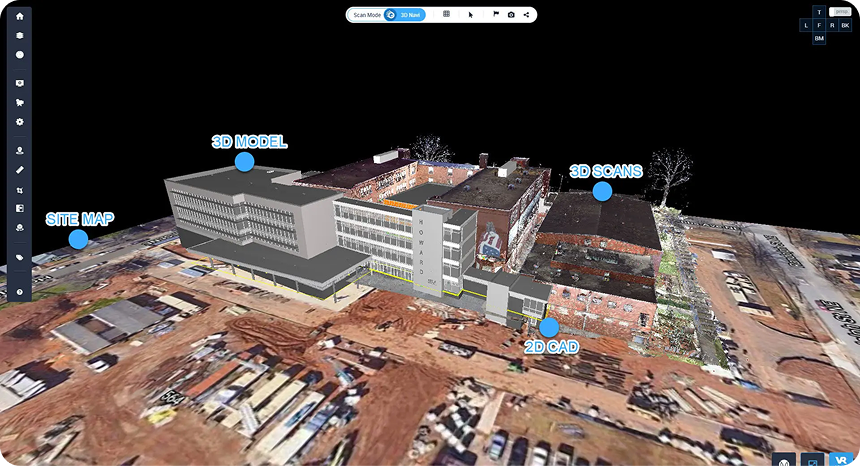
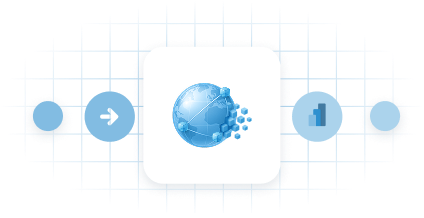
An operational digital twin integrates:
.png?width=546&height=577&name=feture-intro-1%201%20(1).png)

Documentation such as manuals and P&IDs
Structured asset intelligence

Maintenance and inspection versioning history / archival data
High-fidelity scan data

Analytics and insight-driven dashboards
IoT data / performance data
When these layers can coexist in a single environment, teams no longer have to leave one system to find answers in another – all of it remains connected and the twin becomes the infrastructure for operation-driven insight instead of just 3D viewing.
The foundation of truth, built on reality capture data from a variety of scanners, is best utilized when easily ingested and streamed in a web-based browser. The accessibility and toolsets available make it easy to attain:

Consistent asset understanding across teams and geographies

Cross-functional collaboration without rework or data loss

Faster onboarding of new projects, sites, or acquisitions

Decision-making grounded in current, trusted, real-world conditions
By transforming scan data into 3D meshes to maintain high-fidelity access, navigation and asset understanding, Cintoo makes the operational side of a digital twin accessible and fully connected.
Cintoo can act as an operational hinge, combining reality-based data and 3D models with other integrated information like metadata, IoT, and analytics, enabling these layers to in place, scan data becomes a foundation for operational insight rather than a static reference:
Without structured asset intelligence, organizations cannot standardize workflows, automate inspection planning, connect ERP and EAM systems, or scale insights across facilities.
Cintoo enables structured, reusable asset intelligence directly inside the 3D environment.
Teams can:
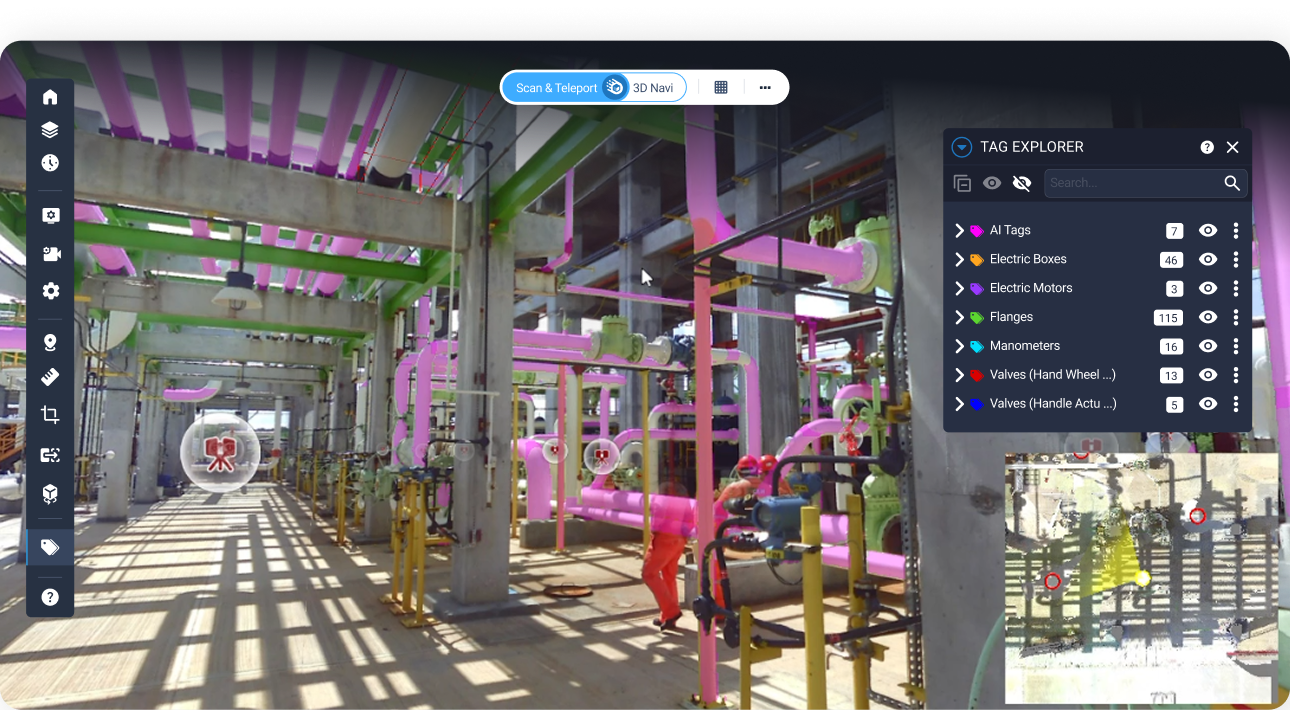
This creates a portable, extensible asset data model that evolves with operational maturity and allows enterprise teams to understand, manage and contextualize assets.
Instead of reactive surveys and fragmented reports, operations teams gain proactive insight that can be used for downstream processes.
As digital maturity increases, asset intelligence supports higher-value workflows:
Inspection prioritization based on risk

Condition assessment in context

Visualization of identified corrosion-prone areas

Pipe routing extraction
IoT systems generate enormous volumes of performance data like pressure, vibration, emissions, and battery levels. Cintoo connects IoT streams directly to asset tags within the reality-based digital twin. Now teams see not just what is happening but where. This enables:
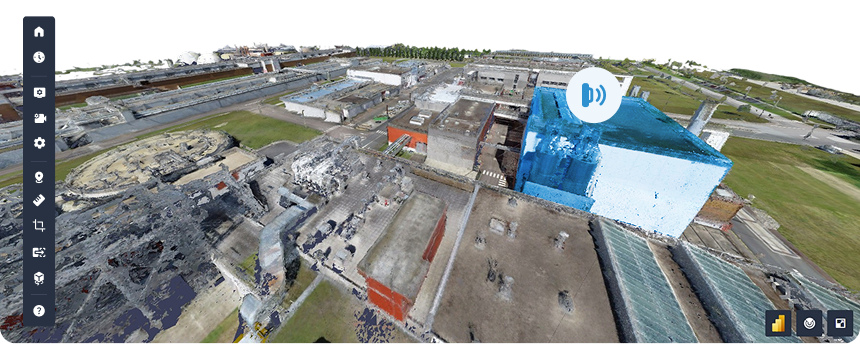
Unplanned downtime remains one of the largest cost drivers in industrial environments. Reactive maintenance has the potential to create emergencies, production disruptions, safety exposures and erosions. When scan data, asset intelligence, maintenance history, and IoT performance converge together, the digital twin provides the operational context to eliminate risks proactively.

Compare current conditions to historical baselines

Plan interventions remotely

Validate asset accessibility before dispatch

Schedule maintenance proactively
Predictive maintenance can scale across facilities without losing site-specific detail. This helps companies avoid unexpected shutdowns or reduce planned downtimes.
Critical documentation like P&IDs, process manuals, safety procedurals, schematics and inspection reports remains in separate systems, disconnected from the reality-based foundation. Instead of this, Cintoo powers connectivity between 3D as-built conditions and 2D documentation with its P&ID Explorer. This allows users to integrate documentation where it appears in a side-by-side view to the 3D data while still having full access to platform capabilities like BIM model comparisons. Ultimately, this helps enterprises derive more insight between their documentation and project context.
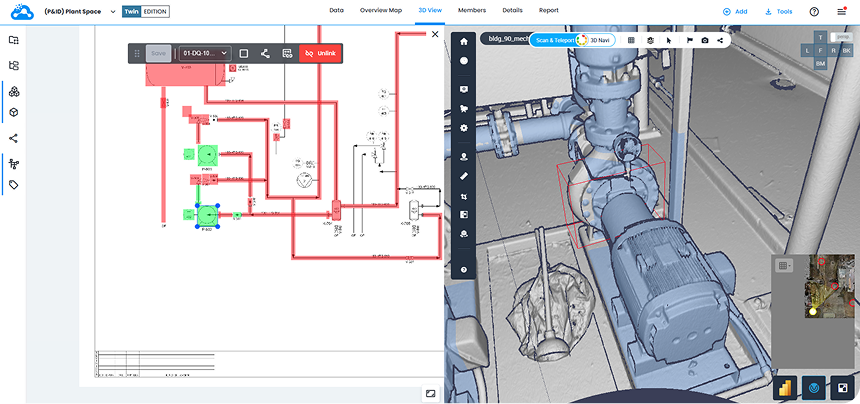
Validate pipe routing and connectivity
To put it into perspective, in using Cintoo for their operationally-driven workflows, Extropic Energy was able to optimize upstream and midstream operations to reduce site visits by 50% and cut unplanned downtime by 10–15%. By improving design coordination and supporting clash detection, Cintoo helped lower project rework and schedule delays by 20–30%.
The Extropic Energy story is a perfect example of the ROI that becomes available when data is operationalized. By acting as a connective and actionable layer, Cintoo enables enterprises to scale project delivery across teams, facilities, and entire asset and project lifecycles.